Syria: Preliminary Agreement to Integrate SDF into Syrian Army and Comprehensive Ceasefire
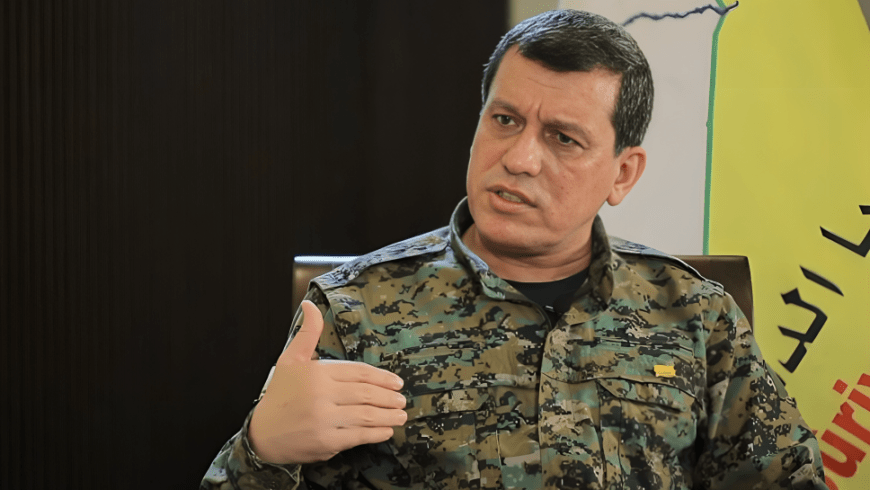
The Commander of the Syrian Democratic Forces (SDF), Mazloum Abdi, announced a preliminary agreement with the Syrian transitional government to integrate his forces into the official military institution. This step is described as paving the way for unifying efforts in the war against terrorism, specifically against ISIS, and activating the political settlement process in the country.
Meetings in Damascus and Evaluation of the March Agreement
In an interview aired on Ronahi TV, Abdi stated that the transitional government in Damascus has expressed readiness to benefit from the combat experience of the SDF. He emphasized that the process is based on guarantees preventing the recurrence of past violations and respecting the sacrifices of SDF members and the families of martyrs, describing this as a “red line.”
Abdi added that his recent meetings in Damascus with the transitional Prime Minister Ahmad Al-Shar’a and Defense Minister Asaad Al-Sheibani were “positive and transparent,” and involved reviewing delays in implementing the March agreement, which had not been fully activated during the past six months. He noted that both parties agreed on new mechanisms to accelerate dialogue and build trust.
Field Agreements and Comprehensive Ceasefire
The SDF Commander confirmed reaching a special ceasefire agreement in the Sheikh Maqsoud and Deir Hafer areas, with an initial commitment to a comprehensive ceasefire on all fronts under joint security arrangements coordinated through military and administrative joint bodies. A broad meeting between the SDF leadership and the Syrian Ministry of Defense is planned soon.
Discussions on Decentralized Governance and Constitution
Regarding the future shape of the Syrian state, Abdi stressed ongoing dialogue with Damascus on implementing a decentralized governance system within a unified state. He acknowledged differences in interpreting some concepts but highlighted a “mutual desire to understand and progress.” He also revealed plans to visit Syrian provinces to review current administrative models and propose improvements.
He pointed out that the March agreement has not yet been incorporated into the constitutional declaration, but authorities in Damascus do not oppose this step amid upcoming consultations with the constitutional committee to include the understandings in the transitional phase documents.
Gradual Security and Institutional Integration
On the security front, Abdi explained that the preliminary agreement includes integrating the SDF’s internal security forces into the Syrian Ministry of Interior, alongside arrangements for integrating military units through technical meetings with the Ministry of Defense. He expressed optimism about the prospects of implementation, stating that “Al-Shar’a is open to our views, and negotiations and implementation will occur in an organized manner.”
Talks with Washington and International Initiatives
Abdi disclosed meetings held with U.S. Ambassador Tom Barrett and Admiral Brad Cooper, during which they discussed future cooperation in combating ISIS and a U.S. proposal to form a joint Syrian-American force in coordination with Damascus.
He also mentioned indirect discussions about lifting U.S. sanctions under the “Caesar Act,” considering that progress on the ground and politically, along with Damascus’s participation in anti-terrorism efforts, could open the door for easing economic measures.
Humanitarian Issues and Return of Displaced People
On the humanitarian side, Abdi called for internal Syrian solutions to security breaches and foreign interventions, prioritizing the return of displaced persons to Afrin, Serekaniye, and Tel Abyad, and activating the Aleppo agreement signed in April 2025 regarding Sheikh Maqsoud and Al-Ashrafieh areas.
He emphasized that issues in Raqqa, Deir Ezzor, and Hasakah are linked to the constitutional process and the form of governance, stressing the need for local representation in all stages of national dialogue. He clarified that withdrawal from certain sites is non-negotiable within local understanding arrangements.
Conditional Openness to Turkey
In concluding remarks, Abdi indicated that communication channels with Turkey remain open, noting the possibility of Ankara supporting the ongoing understandings “if it shows seriousness in implementing them,” as he put it.