Syria After the Fall of the Baath Regime – A Power Struggle and Rising Violence
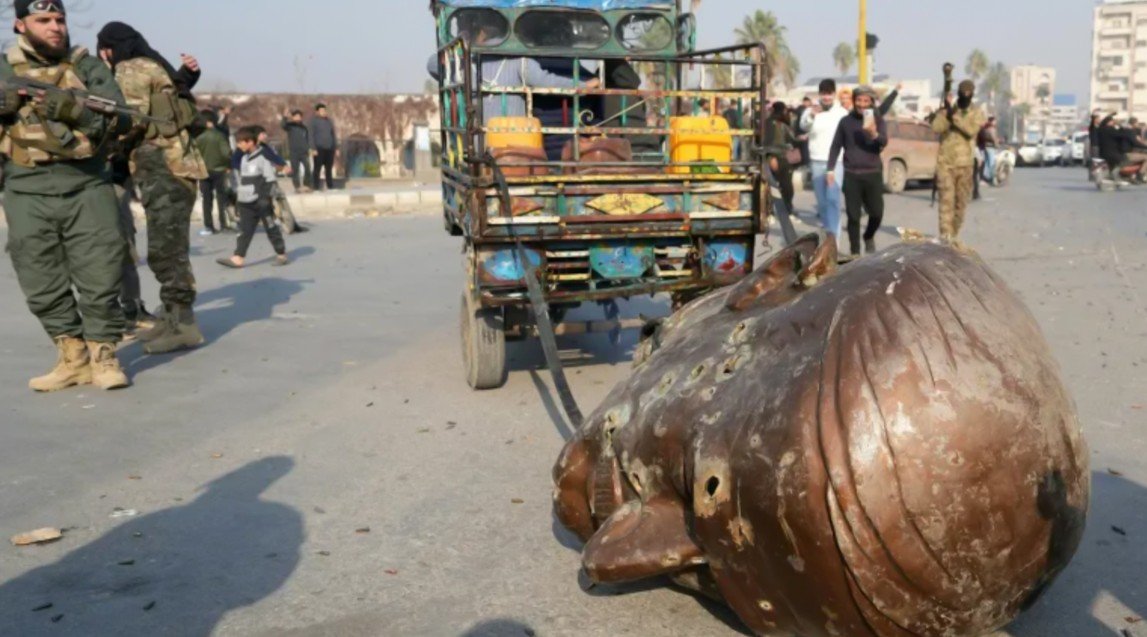
The fall of the Baathist regime in Syria sparked waves of celebration across various Syrian regions; however, the scene of joy did not last long, as rapid political, military, and security steps taken by the transitional government led by “Hayat Tahrir al-Sham” were viewed by observers as indicators of an authoritarian trajectory that threatens to prolong conflicts and deepen divisions.
Early Steps to Consolidate Control
In the weeks following the fall of the regime, Hayat Tahrir al-Sham moved to expand its influence across the political and military landscapes, amid an almost complete exclusion of various Syrian political currents and social components. These moves directly impacted the structure of the new authority and the situation on the ground.
The “Victory Conference”: Cementing Military Dominance
On January 29, 2025, the group held the “Victory Conference” with the participation of its affiliated armed groups and Turkey-backed mercenaries, without including other political or social forces. The conference resulted in a series of decisions that strengthened the transitional government’s authority, most notably:
• Appointing Ahmad al-Shar’a as President of Syria during the transitional phase and granting him wide powers, including international representation.
• Authorizing him to form a temporary legislative council without defined checks.
• Dissolving the security services and the army and creating alternative institutions.
• Abolishing the 2012 Constitution.
Analysts believe these decisions granted al-Shar’a sweeping executive, legislative, and judicial powers in the absence of a clear constitutional framework to govern the transitional period.
Controversial Military Appointments
Following the conference, a series of appointments were made to sensitive positions in the Ministries of Defense and Interior, as well as in army commands and divisions, in favor of leaders of factions loyal to the new government, including individuals accused of committing violations and war crimes such as Muhammad al-Jasim “Abu Amsha” and Saif Boulad “Abu Bakr.”
Influential military positions were also granted to foreign fighters linked to al-Qaeda, raising international concerns about the seriousness of building a unified national army.
Political Decisions That End Pluralism
Politically, al-Shar’a announced in a “presidential” address the formation of a preparatory committee to select members of the People’s Council without elections, entrenching a centralized presidential system that contradicts the demands of broad Syrian sectors for democracy and decentralization.
The new government was formed from figures affiliated with Hayat Tahrir al-Sham at a rate of 98%. Local sources reported the presence of a “sheikh” in every government institution with broad administrative and security powers.
The government also announced the creation of the “General Secretariat for Political Affairs,” a body affiliated with the Ministry of Foreign Affairs that operates through offices in the provinces to manage political and social life—a move likened by observers to the recreation of Baath Party mechanisms in managing public space.
A Constitutional Declaration Without Consensus
Despite abolishing the 2012 Constitution and dissolving the People’s Council, no immediate constitutional alternative was proposed, resulting in a vacuum that lasted until March 2025, when the government announced the issuance of a new constitutional declaration without broad consultations with political and social forces.
Syrian opposition voices have expressed fears that the declaration has reinstated one-party rule and a single identity, while strengthening presidential authority at the expense of the principle of separation of powers.
A Notable Rise in Violence Levels
These political and military developments coincided with escalating waves of violence across various Syrian regions. Between December 8, 2024, and the end of November 2025, 10,923 people were recorded killed due to acts of violence and violations committed by the transitional government and local actors, including:
• 8,180 civilians (438 children and 620 women).
• 1,700 individuals—mostly from the Alawite community—in a massacre committed by government forces and allied groups in March 2025.
• 638 killed in an attack on Suwayda province in July 2025.
In Homs, violent incidents carried out by members of the Bani Khalid tribe in Alawite neighborhoods resulted in the death of two people and the injury of ten others, according to the Supreme Alawite Islamic Council.
Overall Assessment
Available indicators suggest that since the early days following the fall of the Baathist regime, the transitional government has adopted a trajectory based on consolidating absolute control through political, security, and military tools, without real inclusion of other Syrian components. This approach has led to a constitutional vacuum and a decline in political life, alongside escalating violations and violence, further complicating the transition toward a stable and inclusive state.