Currency Change in Syria Raises Questions About the Fate of Old Liquidity
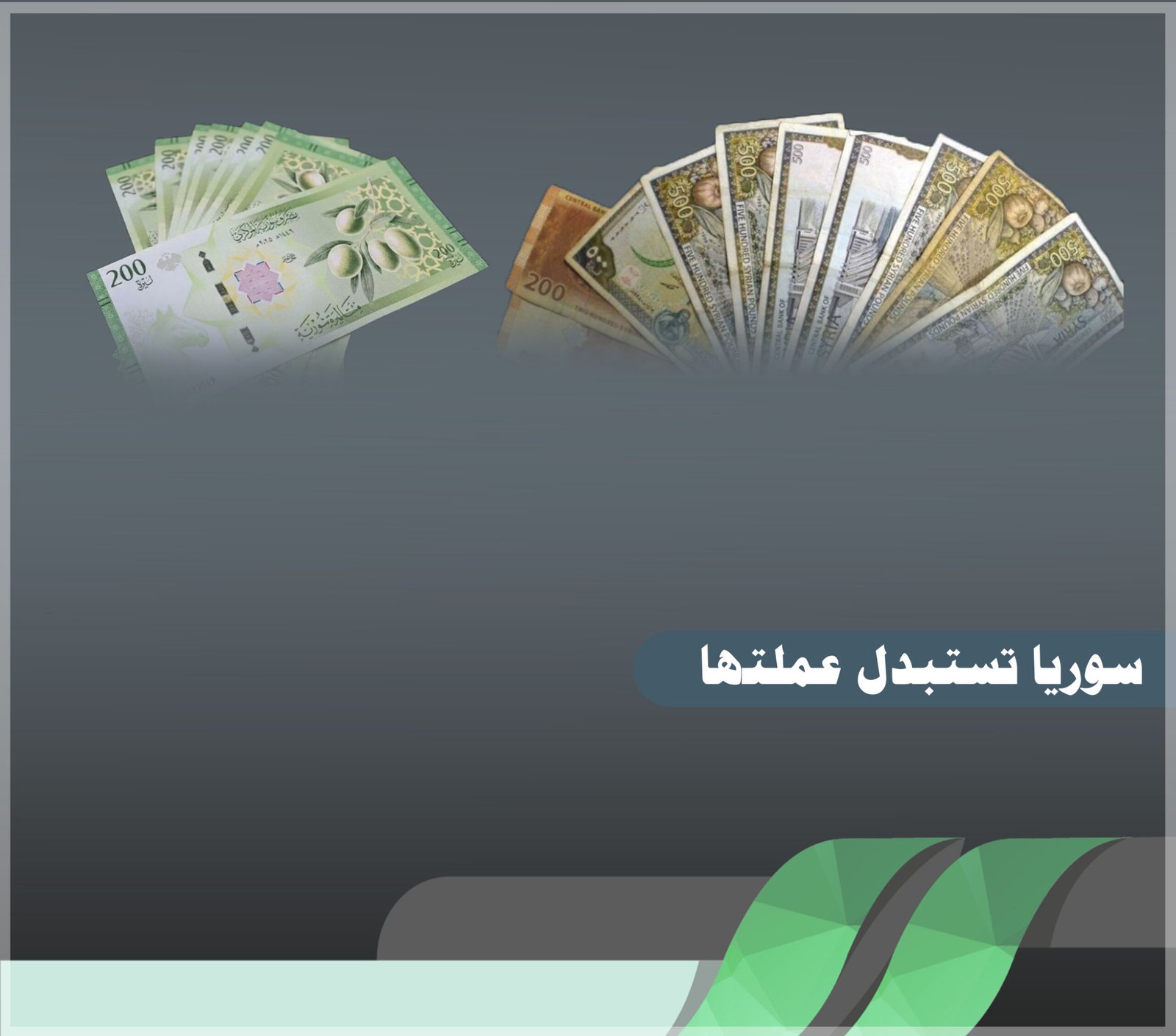
The introduction of the new Syrian currency into the markets, following Damascus’ decision to remove two zeros from Syrian pound denominations, has raised widespread questions about the fate of large cash holdings of the old currency stored inside and outside the country, especially amid reports of smuggling quantities of it to neighboring countries over past years.
Syrians questioned the mechanism for dealing with these banknotes, and whether the currency exchange will affect undeclared funds or money linked to illegal activities, at a time when economic experts have offered differing readings of the dimensions of the decision and its repercussions.
In this context, academic and economic expert Lana Badfan described the decision to change the Syrian currency as going beyond a purely technical monetary measure, considering it a step with sovereign, economic, and political dimensions. She said the decision represents what she termed sovereign engineering to eliminate runaway liquidity, by absorbing inflation and reducing the money supply through removing large cash blocks from circulation due to their failure to enter the banking system.
Badfan added, in a statement to Al Arabiya.net/Al Hadath.net, that the step carries a political dimension embodied in imposing “forced transparency” on informal money networks, placing parallel powers and warlords before the choice of revealing the sources of their funds or losing them, which contributes—according to her—to dismantling influence networks linked to smuggling and terrorism financing.
She pointed out that, from a sovereign perspective, the decision helps end the phenomenon of cross-border liquidity in neighboring countries such as Lebanon, Turkey, and Iraq, and re-centralizes financial power within the state’s central framework, in line with centralization policies aimed at controlling the economy and preparing for the reconstruction phase.
On the other hand, academic and economic expert Ammar Youssef presented a less severe reading of the repercussions of the decision, noting that the currency change process had been expected for about a year, prompting many holders of the Syrian pound abroad to bring their money into the country or convert it into foreign currencies or gold.
Youssef explained, in his remarks to Al Arabiya.net/Al Hadath.net, that most corruption operations during the era of the former regime were conducted in foreign currency or gold, not in the Syrian pound, due to its deteriorating value, which makes the stored quantities limited, except for those held by money changers, whose sources of funds are known.
Youssef also downplayed concerns related to the impact of the currency exchange on savings in Syrian pounds, considering that the government’s announcement of its intention to change the currency prompted many people to get rid of it over the past year.
The transitional government in Syria had officially announced, days ago, the introduction of the new currency by removing two zeros, in a step it described as representing the beginning of a new economic phase, after one year since the fall of Bashar al-Assad’s regime. The head of the transitional government, Ahmad al-Sharaa, considered the currency change to be a title marking the fading of a previous, unregretted phase, and the beginning of a new phase to which the Syrian people aspire.