North and East of the Euphrates: Between Border Settlement and Strategies of Influence

The battle of Sheikh Maqsoud and other Aleppo neighborhoods was not a war in the traditional sense, nor did it constitute a real loss for the Syrian Democratic Forces (SDF). Rather, it can be described as a border settlement. Between the media “victory” celebrated by some channels and media pages supportive of the mercenaries of the transitional government, and the limited resistance with light weapons against more than 40,000 fighters backed by drones, heavy weapons, and tanks, the confrontation ended after four days with a truce and the withdrawal of fighters to east of the Euphrates.
In April 2025, the SDF withdrew from the neighborhoods of Sheikh Maqsoud, Ashrafieh, and Bani Zaid in Aleppo, while the local “Asayish” forces—composed of residents of the neighborhoods—were integrated to assume security duties after the Sharaa authority violated the agreement, driven by Turkish support and under the supervision of the High Commissioner Tom Barrack.
The Syrian Democratic Forces (SDF) have repeatedly confirmed that they have no presence inside the Aleppo neighborhoods. The battle of Sheikh Maqsoud highlighted adherence to the agreement, as the SDF withdrew its fighters, wounded, and martyrs to east of the Euphrates, where burial ceremonies were held. It is worth noting that the targeted sites are less than 60 km from areas under SDF control—i.e., less than an hour away—confirming that the Syrian leadership realized that the battle was a trap intended to draw the SDF into the conflict.
These events clearly illustrate the extent of the geographic distribution and influence of the active forces in Syria: the area east and north of the Euphrates has remained quasi-autonomous since the defeat of ISIS. The Aleppo battle did not affect this reality; rather, it granted the SDF greater room for maneuver and a fortified strategic depth. Accordingly, the withdrawal from the two Aleppo neighborhoods cannot be described as a loss for the SDF, but rather as an opportunity to secure a continuous front along the Euphrates River, with military mobilization focused in areas such as the Tishrin Dam, west of Lake Euphrates, and Deir Hafer.
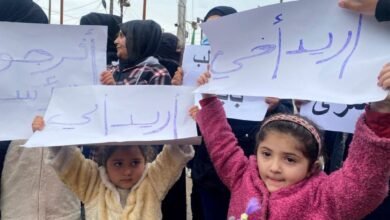
The Syrian Democratic Forces (SDF) have also strengthened their position as an effective actor in achieving stability, overcoming cases of popular unrest resulting from the displacement of Kurds in Aleppo by mercenaries of the transitional government backed by the Turkish state, and reaffirming their role as a model of a multi-sectarian state capable of curbing forms of extremism and violence.
International Movements and the Scenario of Syria’s Partition
The situation in Syria remains linked to international agreements and the states active in the Syrian file, particularly with the continuation of meetings between the mercenaries of the transitional government and Israelis in Paris and the signing of multiple agreements, including the effective relinquishment of Syrian territories in the south, including the Golan, and shifting the discussion from the 1967 borders to the 1974 borders.
Observers outline that north and east of the Euphrates will initially form a quasi-independent entity, while future battles will be concentrated west of the river to determine the borders of “Rojava.” Consequently, the battle of Sheikh Maqsoud is not a loss for the SDF, but part of a redrawing of engagement lines. The withdrawal of fighters to east of the Euphrates represents a consolidation of boundaries of influence and control, while maintaining the Autonomous Administration as it is in the areas extending north and east of the river.
Deir Hafer remains a decisive point along these boundaries, as reinforcements of the mercenaries of the transitional government backed by the Turkish occupying state continue to arrive in the area, raising the possibility of the outbreak of a comprehensive military action affecting Deir Hafer and Maskanah, the last two areas under SDF control west of the Euphrates River.