Iran Protests Enter Second Week Amid Deaths and U.S. Warnings
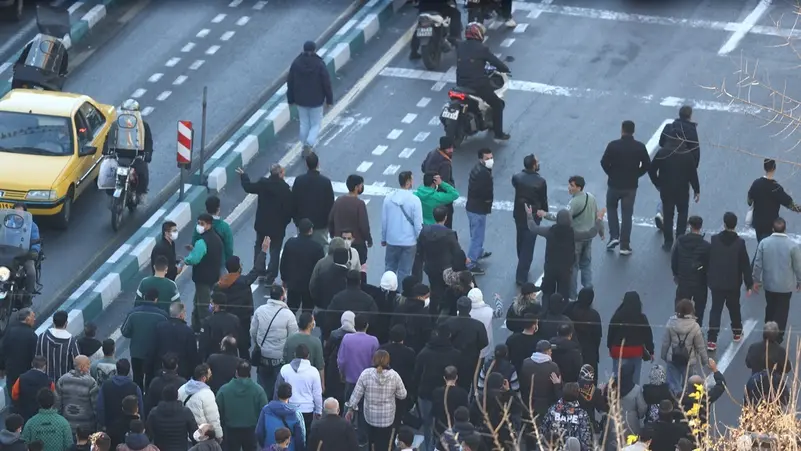
Popular protests in Iran have entered their second week, with renewed clashes between demonstrators and security forces in several cities, resulting in deaths, injuries, and widespread arrests, according to human rights organizations and Iranian and international media.
According to a tally based on official reports, at least 16 people have been killed since the protests began on December 28, including members of the security forces. The movement initially erupted following a strike by shop owners in Tehran’s Grand Bazaar in protest against worsening living conditions.
U.S. President Donald Trump warned on Sunday that Iran would face “a very strong strike from the United States” if more protesters are killed, stressing that Washington is ready to act should the killings continue.
For its part, the Iranian human rights organization HRANA, based in the United States, reported nighttime protests in Tehran and the southern city of Shiraz, as well as in western regions of Iran considered a major hub of the unrest, where slogans critical of the authorities were chanted.
These protests are considered the most significant since the widespread demonstrations that swept Iran in September 2022 following the death of a young woman after her detention by the morality police. However, they have not yet reached the scale of those protests, nor earlier movements such as the 2009 Green Movement or the 2019 demonstrations.
The latest protests have been concentrated in densely populated western areas of the country, home to Kurdish and Lur minorities, and have spread to 23 of Iran’s 31 provinces, encompassing at least 40 cities, most of them small and medium-sized, according to statistics compiled by Agence France-Presse.
Human rights organizations have published videos showing bloodied bodies lying in the streets. In this context, Iran’s Mehr News Agency reported the death of a member of the Islamic Revolutionary Guard Corps during clashes with what it described as rioters near a police center, while Fars News Agency said that protesters attempted to storm a security facility, resulting in the deaths of two of them.
In Tehran, sporadic demonstrations were reported in eastern, western, and southern neighborhoods. Most shops remained open, despite reduced street activity and the deployment of riot police at major intersections. Images showed security forces using tear gas to disperse protesters in central areas of the capital.
Politically, these developments come amid mounting challenges facing Iran’s leadership, particularly Supreme Leader Ali Khamenei, who has held power since 1989, following a 12-day war with Israel in June that caused damage to nuclear and military infrastructure and resulted in the deaths of senior security figures.
On the economic front, government spokesperson Fatemeh Mohajerani announced that citizens will receive monthly support equivalent to 7 U.S. dollars for four months, in an attempt to contain public anger.
In response, Iranian Foreign Minister Abbas Araghchi described Trump’s remarks as reckless, warning that Iran’s armed forces are on high alert in the event of any foreign intervention.
Meanwhile, the UN Special Rapporteur on the situation of human rights in Iran, Mai Sato, expressed concern over the escalating confrontations, warning of a repeat of the violent response witnessed during the 2022–2023 protests. HRANA also confirmed the arrest of at least 582 people over the past week.