Al-Shibani Reveals How the Opposition Dealt with Russian Forces Before the Fall of Assad’s Regime
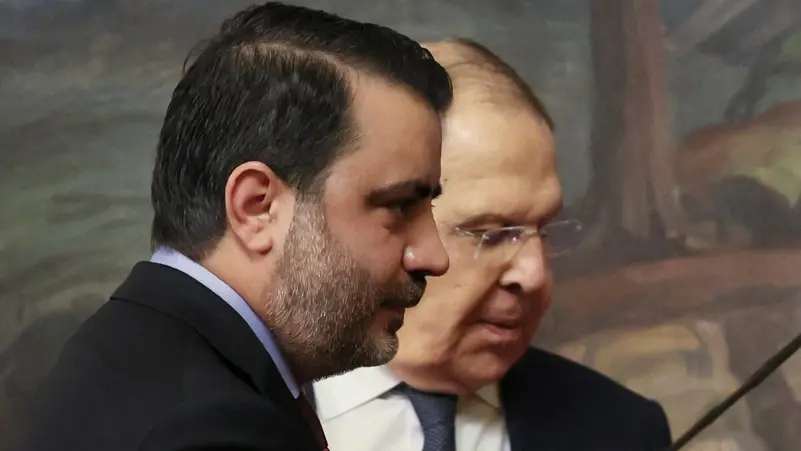
As the anniversary of the fall of Syria’s former regime under Bashar al-Assad approaches, the Foreign Minister of the Syrian Transitional Government, Asaad al-Shibani, revealed details about how the opposition interacted with the Russian military presence in Syria prior to December 8, 2024.
In an interview with Al-Majalla magazine, al-Shibani said that the armed factions sought to understand “Russia’s interest in Syria,” and whether it was linked to supporting the former regime or to preserving its strategic interests in the country. He added that this approach helped the opposition reduce the risks of Russian airstrikes during their advance toward the capital, Damascus, while neutralizing the fronts where Russian forces were present.
Al-Shibani noted that the head of the Syrian Transitional Government, Ahmed al-Shar’a, led the operation and considered the midpoint of the campaign the appropriate time to engage with Russian officials, following the liberation of Aleppo and the beginning of the offensive to liberate Hama. He added that communication was conducted through a direct channel with a senior Russian authority, not through intermediaries, and that the first statement sent by the opposition attracted Moscow’s attention.
He continued that a subsequent face-to-face meeting was held at the Bab al-Hawa crossing, during which the Syrian delegation informed its Russian counterpart that Moscow’s support for the former regime was a mistake, and that the Syrian people sought change. He also emphasized the possibility of aligning Russia’s interests with the new government on a national basis, away from deals or militias.
Al-Shibani explained that one of the key points in the negotiations was that the fall of Assad did not mean Russia would leave Syria, and that the Syrian side requested that Russia reduce airstrikes on major cities, halt political and media incitement against the opposition, and arrange future meetings to discuss the repositioning or partial withdrawal of Russian forces.
Al-Shibani concluded by saying that the Russian delegation inquired about the factions’ expectations for reaching Damascus, and the response was that it was possible within 48 hours.
It is worth noting that al-Shibani and al-Shar’a visited Moscow a few weeks ago and confirmed that relations between the two countries had begun to be built on new foundations. It should also be noted that Russia supported the former regime for years and deployed its forces at two main bases in Syria: Hmeimim and Tartus.