Rubio from Israel: Ensuring Gaza Ceasefire Durability Is Essential
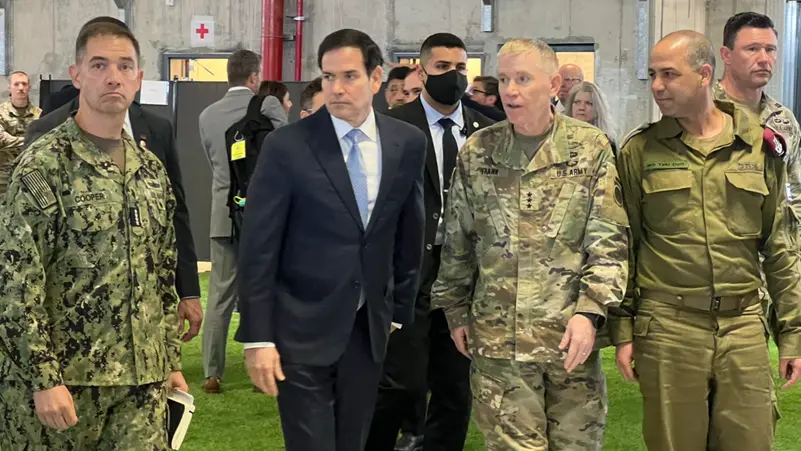
U.S. Secretary of State Marco Rubio visited Israel on Thursday, where he met with Prime Minister Benjamin Netanyahu before inspecting the Civil-Military Coordination Center in the country’s south on Friday.
During his tour, Rubio stressed that ensuring the durability of the Gaza ceasefire is a top priority before the reconstruction phase begins, noting that Washington is closely monitoring the implementation of the agreement tied to the peace plan proposed by the previous U.S. administration.
International Force and Stability
Rubio stated that the long-term objective is the reconstruction of the Gaza Strip, while underscoring the need to deploy an international stabilization force in the territory as soon as possible, under United Nations authorization.
He added that Israel will help determine which countries will contribute troops to this force, noting that its formation is not yet complete, though several nations have expressed willingness to participate.
The U.S. Secretary of State said matters were “moving in the right direction” regarding the Gaza agreement, but emphasized that sustaining the truce is a fundamental condition for any progress in reconstruction efforts.
Hostage Issue and Hamas Disarmament
Regarding the hostage issue, Rubio affirmed that Washington will not abandon the file, adding that efforts are underway to ensure the return of all bodies to Israel.
He stressed that Hamas’s disarmament is an essential part of the agreement, explaining that the movement has agreed to the step and that any refusal to comply would be considered “a violation of the agreement” and could trigger a resumption of hostilities.
Rubio also emphasized that “there will be no peace if any organization attempts to attack Israel from Gaza,” reiterating that Hamas will have no role in the territory’s future.
He confirmed that Washington is working to ensure Gaza poses no security threat to Israel, reaffirming U.S. commitment to Israel’s security and to the success of the peace plan.
West Bank and Humanitarian Aid
Addressing developments in the West Bank, Rubio described the Knesset’s recent vote on annexation as an attempt “to embarrass Netanyahu,” adding that he does not believe Israel will move to impose sovereignty there, as such a move would “threaten the Gaza agreement.”
On humanitarian aid, the U.S. diplomat said that UNRWA has effectively become an arm of Hamas, adding that the United Nations is now the body responsible for coordinating aid delivery in Gaza.
He described recent developments in the Strip as “historic and unprecedented,” reaffirming Washington’s commitment to implementing all clauses of the Gaza agreement, while noting that the Trump administration’s plan for Gaza is long-term in scope.
Gaza Plan and Its Phases
The first phase of the Gaza Plan, which came into effect on October 10, stipulates a ceasefire and the release of hostages. However, it remains fragile following several Israeli violations, amid intensive U.S. efforts to stabilize the truce and move toward the second phase.
The second phase includes reconstruction of the Gaza Strip and the removal of weapons.
According to Israel Hayom newspaper, Rubio’s visit focused on forming a transitional government in Gaza under the peace plan’s framework — to be administered by Palestinian technocrats under the supervision of an international committee whose structure and membership are still under discussion.
Hostage File
Since the Gaza ceasefire took effect on October 10 under President Donald Trump’s plan, Hamas has handed over the remains of 15 captives to Israel, while the bodies of 13 other hostages are still awaiting repatriation from the enclave.