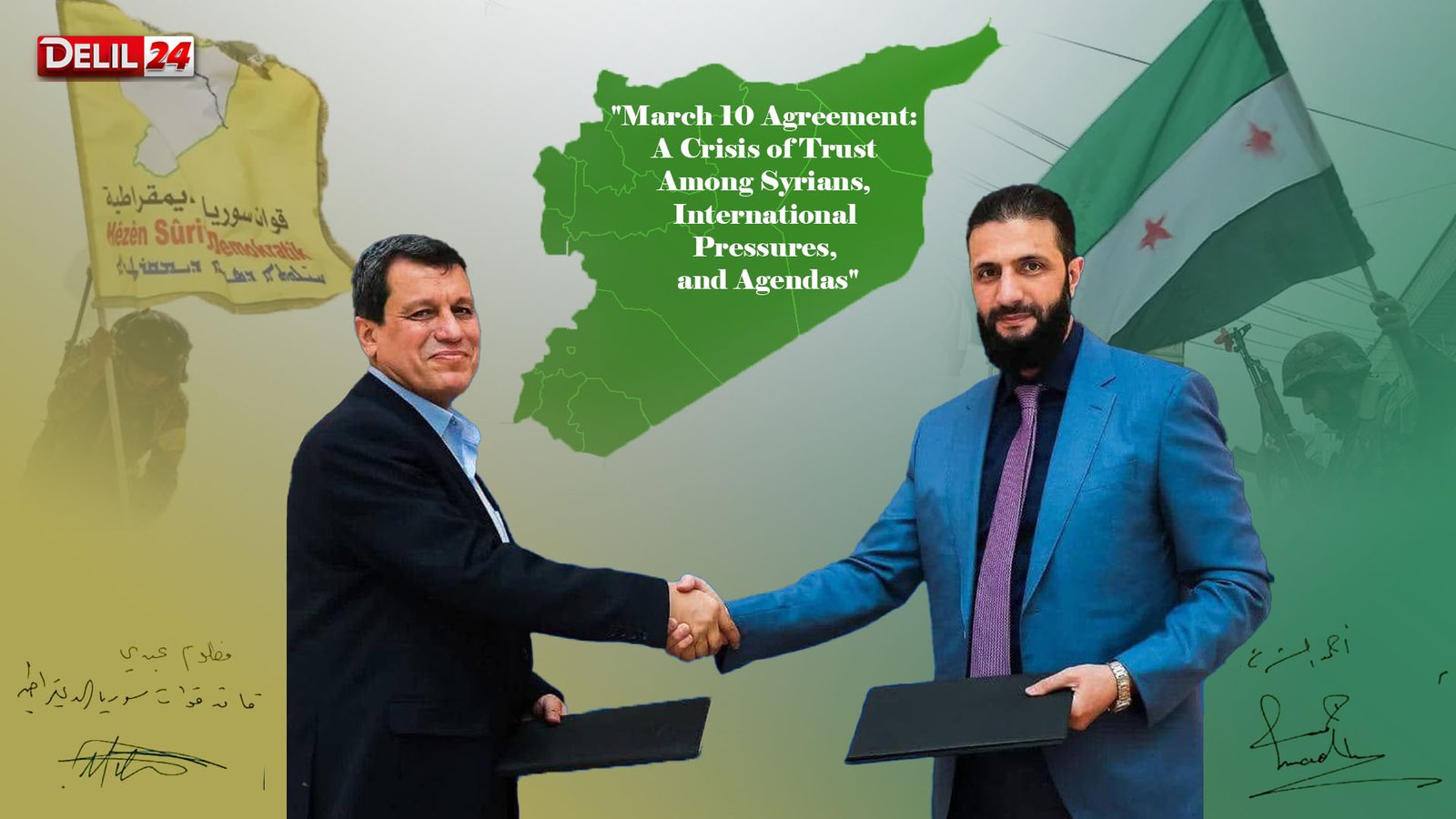
years of internal conflict and foreign interventions, and with the fall of the Assad regime, the Syrian parties began to realize the necessity of reaching a comprehensive political settlement. International and regional pressures, in addition to military changes on the ground, pushed the parties towards dialogue.
The Self-Management, which holds autonomy in northeastern Syria, sought to secure Kurdish rights and stabilize its regions through a decentralized system. Meanwhile, the Syrian Interim Government aimed to restore its sovereignty over all Syrian territory.
In this context, the March 10 Agreement represents a significant political event. It was concluded between the Syrian Interim Government and the Syrian Democratic Forces (SDF), emerging amid major political and security shifts. It is considered an important step toward rearranging the internal Syrian scene. The eight clauses of the agreement emphasize:
- Ensuring the rights of all Syrians to represent and participate in the political process and state institutions without religious or ethnic discrimination.
- Recognizing the Kurdish community as an integral part of the Syrian state and guaranteeing their constitutional rights.
- A ceasefire across all Syrian territories.
- Integrating civilian and military institutions in northeastern Syria into the management of the Syrian state, including crossings, airports, oil and gas fields.
- Ensuring the return of displaced Syrians to their areas and providing protection for them.
- Supporting the state in combating remnants of the previous regime and all threats to Syria’s security and unity.
- Rejecting calls for division, hate speech, and attempts to incite discord among the components of Syrian society.
- Confirming that executive committees are responsible for implementing the agreement by the end of 2025.
More than five months after the agreement was signed, several steps have been taken, such as the formation of an executive committee that held its first meeting in Hasakah to discuss implementation mechanisms. A delegation from the Self-Management also held several rounds of talks in Damascus to continue the agreement. A significant outcome of the agreement was the ceasefire across all Syrian territories, including Al-Sheikh Maqsoud and Ashrafiya neighborhoods in Aleppo. This was followed by the withdrawal of the SDF from the two Kurdish neighborhoods in Aleppo, a reduction in military representation, the release of the first batch of 450 detainees from both sides, the closure of certain prisons, and the establishment of joint security centers between the SDF and security agencies in Aleppo.
Reasons for the halt or delay
Subsequent political events, such as the announcement of the constitutional declaration, the appointment of an interim government, military operations on the Syrian coast against Alawites, and attacks on Druze in Suwayda`a, as well as the People’s Assembly elections, led to the Self-Management’s rejection and delayed the agreement’s progress between the two parties. The reasons for this delay can be summarized as follows:
Disagreement over the interpretation of the integration of institutions clause. Damascus views integration as a final solution and a return to a centralized system, while the Self-Management believes in coordination while maintaining some powers within a decentralized system.
As so, the intervention of regional and international powers, particularly Turkey, which is pressuring the Interim Government and closely monitoring the agreement, has been a significant reason in the agreement’s progress. Which also the military friction between the two sides in Deir ez-Zor and eastern Aleppo also plays a role.
The Current Reality and Future Political Analyses
As the end of the current year approaches and with no indication of the implementation of the agreement, the current reality can be defined by several points:
Crisis of trust and fragility of relations and mutual doubts between the parties pose a major challenge to the sustainability of the agreement. As the differences in interpreting the clauses and the dispute over the integration of civil and military institutions may halt the implementation or bring disputes back to the forefront.
The regional and international interventions: The support or pressure from the guarantor states as (Turkey, the United States, Russia, the European Union) will affect the stability of the agreement.
The importance of gradual implementation: Gradual progress in sensitive issues such as education, security, and detainees strengthen the chances of success for the agreement.
As the possible future scenarios remain wide open: either optimism and gradual resolution of disputes, continued executive meetings, and international support, leading to overall de-escalation and possibly broader constitutional negotiations. or hardline positions and continued fundamental disagreements, with the intervention of regional powers, partially halting implementation and resuming military friction. or stagnation through partial implementation of some clauses, while major issues remain unresolved, maintaining a fragile stability without tangible progress.
What is required from both parties to ensure the success of the agreement?
Many of the policies pursued by the Syrian Interim Government have faced international and local rejection, such as the failure to involve all parties in the transitional phase and its policy of exclusion, as others describe it, which weakens its position both internationally and locally. The government must commit to an inclusive interpretation of the clauses, provide security guarantees for the northern and eastern regions, facilitate the voluntary return of displaced persons, especially those from Afrin and Ras al-Ain, and move away from a centralized approach in governing the country.
And Both parties must commit to the executive committees and follow up on the implementation of the agreement, avoiding media or military escalation, involving the international community and the guarantor states to support the implementation, and applying measurable gradual steps to build trust progressively.
The implementation of the March 10 Agreement represents a rare opportunity to achieve political and security stability in Syria through a ceasefire, coordinating civilian and security institutions, building trust between the Syrian Interim Government and the Self-Management, ensuring the rights of all Syrians and different components, including the Kurdish community, and also protecting cultural and religious diversity, achieving justice and national reconciliation through the return of displaced people and the release of detainees, improving public services, and paving the way for broader constitutional negotiations, This makes it a crucial step toward a stable and peaceful future for Syria.
Siamaand Ahmad